Some time ago, I promised a post with more information about Robert Tibbles was coming soon. Here’s the post. I know it wasn’t really soon after the first post on Robert, but I guess “soon” can be a matter of perspective. Anyway, if you didn’t read my earlier post about Robert and the great Alaskan earthquake that caused a giant tidal wave, as well as a landslide that took Robert’s life, be sure to read it. I’ll post the link at the ned of this post.
Robert Tibbles was born in Lakeview, Montana on March 3, 1913 to Walter Stillman Tibbles and Esther E. Rote. Esther is the daughter of Margie Parmer, who is Samuel and Hettie Parmer’s daughter. Lakeview, MT, which today is near the entrance of both Red Rock Lakes National Wildlife Refuge and Beaverhead-Deerlodge National Forest, is about 90 miles from Dillon, MT. In 1913, there was no wildlife refuge or national forest, but there was a community of ranchers, railroad workers, and ordinary folks. The Dillon Tribune reported news from the surrounding areas, including Lakeview. I always like browsing through old newspapers. The ads are especially fun to read. I found copies of The Dillon Tribune at montananewspapers.org, which is a website of the Montana Historical Society. The Lakeview section of the March 7, 1913 paper has a short announcement of Robert’s birth, shown below. Small town newspapers are full of gossip. You want to know who went to the big city to go shopping? Just read the paper!
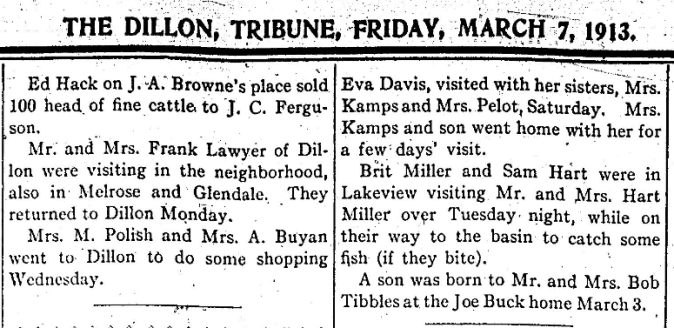
I have not researched if Joe Buck is a relative of the family, or why they were at the Joe Buck home. However, that name will come up again in Robert’s history. We do know from some other records that Robert’s parents were “squatters” on a home in the area.
Robert is found in the 1920 census, at the age of seven, living with his family in Grayling District, Gallatin County, Montana. He lived next to his great aunt and uncle, John and Lizzie Parmer. It is possible they had lived there for some time because Robert’s younger brother, Howard, was born in the area in 1915. Howard’s birth was not registered until 1941. In the birth registration, he is listed as being born in the rural part of Gallatin County, MT, with Lizzie D. Parmer as the attendant for the birth.
Walter and Esther divorced in 1923 after Walter became abusive and abandoned the family. From the court papers, we know that Walter and Esther had 160 acres they were homesteading five miles West of West Yellowstone. Life in the West was difficult, required hard work, and was subject to the harsh elements of the Montana winters. There were no modern conveniences. I’m sure even at 7 years old, Robert was put to work helping the family with chores and such. At some point, his mother remarried and moved to Wyoming.
In 1930, Robert is 17 years old and living with an aunt and uncle in Lima, MT. He was working as a farm laborer. In 1932, he had moved to Monida, a short distance from Lima, and was worked as a ranch hand for Joe Buck. Remember Joe Buck? Robert was born at Joe Buck’s home! He worked for Joe Buck for six weeks, then he got into trouble. He burglarized a pool hall and stole $24. As a result, he spent two years in the state prison.
We next find Robert in Alaska. I wonder–what took him to Alaska? He must have liked it because it seems that’s where he spent the rest of his life. In 1939, he married Dorothy Pauloff, a Native Alaskan Indian. They were both living in Kodiak, Alaska at the time, and that is where they are found in the 1940 census. He had had appendicitis at some point because his WWII draft registration on January 22, 1941 tells us that he had a scar from an appendicitis operation.
Robert and Dorothy had at least two children, but eventually Robert and Dorothy divorced. In 1947, Robert married Eveline V. Sly. And the rest of the story is told in my previous post at A Tragedy in Alaska
Life can be rough, and have ups and downs, good days and bad days. Robert likely had plenty of bad days–witnessing abuse (and possibly being a victim of it himself), abandonment, burglary, prison time, surgery, divorce, etc. At the same time, I’m sure Robert had his share of good days–friends, fatherhood, wedding days, and eating fresh picked berries. Learning from the bad days, and savory the good, even amidst the bad, is what life is all about. Savor the good, and all that is before you. Today can be anything you make it. What will today be like for you?
 parmersancestors.com