Margaret Alice Parmer

Margaret Alice Parmer, more commonly known as Margy, was Born Sept 1, 1871. The Civil War had ended five years previously. In 1871, the Franco-Prussian war ended, The Great Chicago Fire devastated thousands, Jesse James robbed banks, and major league baseball started. Also in 1871, some of the first pictures of Yellowstone Park were taken. Perhaps Samuel and Hetty saw some of those photos, never imagining that their newly born daughter would one day be connected to the park.

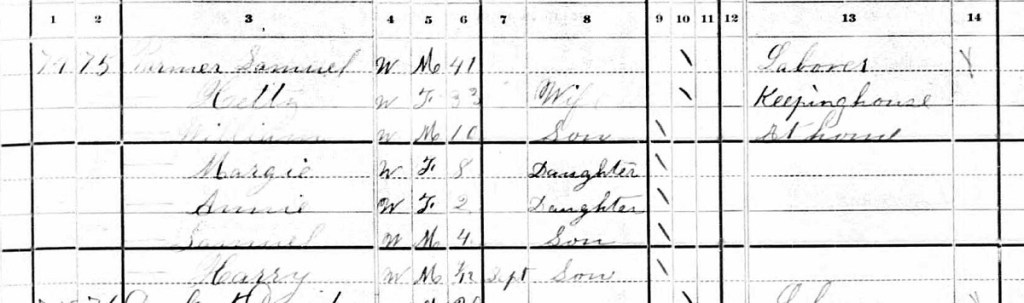
Margy was the third child of Samuel and Hetty Parmer. At the time of the 1880 Census, Margy was 8 years old. The census indicates she had attended school that year. The Census was taken in June 1880. Her father, Samuel, is shown in the census with an occupation of “laborer.” Her oldest brother, John, was boarding at a Farm not too far away, and not too far from the grandparents, John and Martha Parmer. The second oldest child, William, who was 10 years old, was living at home. Margy’s next older sibling had died 3.5 years previous to the census. Also living at home when the census was taken was Samuel at 4 years old, Annie at 2 years old, and Harry at 9 months old . Margaret’s mother, Hetty, would give birth to another child in one month.
With a houseful, no doubt there was plenty that needed done, and Margie, at 8 years old and the oldest daughter, likely had plenty of chores and babysitting duties to keep her busy when not in school. Of course school was quite different then as noted in my post about John Jacob Parmer’s Youth. The 1880 census is of East Lampeter, and it’s interesting that the census does not list any street names. We do have the map showing the location of John and Martha’s property, which you can see at my post about John Jacob Parmer’s Youth.

As is typical for the time period, there are very few records other than a census for the time of a person’s youth until they get married. The marriage license for Margie is similar to that of her siblings, as discussed in my previous post about Marriages, the Minister, and the Church. She was married 5 Sept 1889 by D.W. Gerhard at 131 South Duke St. There’s more info about Rev Gerhard and a video of South Duke St at my previous post, Marriages, the Minister, and the Church. She would have been 18 years old and Abraham, who was 12 years older than her, was 29 years old according to the marriage license. He was occupied as a teamster.
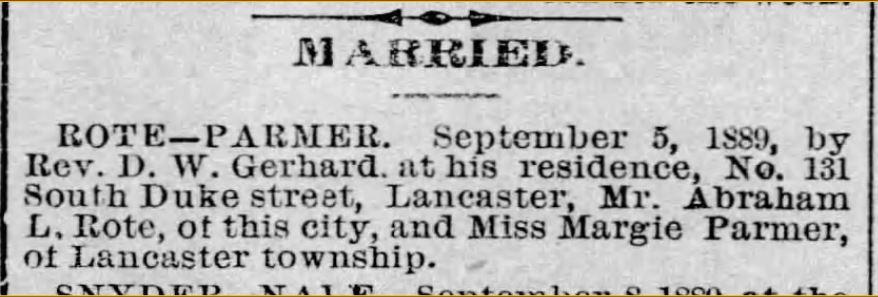
Abraham Rote and Margie Parmer marriage announcement 11 Sep 1889, Wed Lancaster Examiner and The Semi-Weekly New Era (Lancaster, Pennsylvania) Newspapers.com

1890 city directory shows Margie is employed as a millhand and living in Rockland near Old Factory, which is where her father lived. As a millhand, she probably worked in a factory related to textiles. The City of Lancaster’s largest employer in 1880 was the Conestoga Steam Cotton Mills. A nice article about the Mills can be found at https://lifewithldub.blogspot.com/2016/03/the-fabric-of-lancaster-part-i-story.html. You can learn more about textile manufacturing at https://philadelphiaencyclopedia.org/essays/textile-manufacturing-and-textile-workers/. This article focuses on the Philadelphia area, but has a lot of good information, photos, and links for additional resources.

In 1900, we find Margie, living in West Lampeter, married to Abraham Rote and with 5 children: Ester–age 10, Della–age 8, Charles–age 7, Maud–age 6, and Carrie–age 4. Also living at the home is Margie’s brother Harry–age 21, who is listed as a servant. One other individual, 14 year old A[rom] Farrel (the spelling of the first name is difficult to make out), who is listed as a farm laborer and who had been in school for 5 months and was non employed for 5 months (likely while in school), which means he was at 14 years old fully employed when not in school. The younger children had been in school for 7.5 months.

Some time before 1913, Margie and Abraham moved their family West to West Yellowstone, MT. There Abraham worked at and/or managed the Bar N Ranch. We know he was there before 1913 because Margie’s brother John Jacob Parmer and his family succeeded the Rote family in managing the Ranch, and John Jacob Parmer took over that job on June 1, 1913. The Bar N Ranch was mostly used for hay freighted into Yellowstone National Park for the work and stage horses.

Perhaps the Rotes left the Bar N Ranch to start a homestead of their own. A homestead of 160 acres was proved and ownership transferred to Abraham on April 5, 1916. You can see the related documents at the BLM website. As you explore the homestead records, you see many names of the Parmers and Rotes relatives–Battle, Fuller, Gorman, Hutchison, Murray, Rightenour, and Tibbles–who the Parmer’s and Rote’s children married.

Certainly life there in the winter was difficult. It’s possible that they left the area in the winter and returned in the Spring. We next find the family in the 1920 Census.

The 1920 Census shows them living in Ashton, Idaho. Abraham is 60 years old and Margie is 48 years old. They were living with their daughter, Maud, and son in law William R. Hutchinson, and 2 year old granddaughter Vonda.
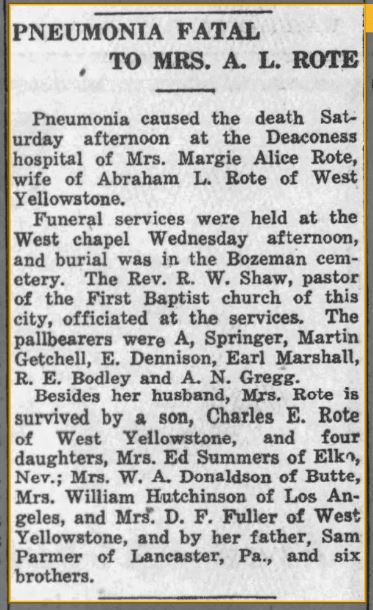
Margie died Nov 27, 1926 of pneumonia at 55 years old, myocarditis contributing. She had lived at 530 Montana Ave, Bozeman, MT for five years according to her death certificate.

Margie Alice Rote death announcement BozemanArticle from 03 Dec 1926, Fri The Bozeman Courier (Bozeman, Montana)

Margie Alice Rote Death Announcement 06 Dec 1926, Mon Lancaster New Era (Lancaster, Pennsylvania) Newspapers.com

Abraham died of a strep infection on Feb 3 , 1933. He was living with his daughter Carrie Rote Fuller at 209 S 7th, Bozeman, MT. He was 73 years old and is listed as being a rancher.

Some of their posterity continued to live in the West Yellowstone area for many years. Others moved to other parts of Montana and to other areas of the country.
A Little More of Robert Tibbles

Some time ago, I promised a post with more information about Robert Tibbles was coming soon.  Here’s the post.  I know it wasn’t really soon after the first post on Robert, but I guess “soon” can be a matter of perspective.  Anyway, if you didn’t read my earlier post about Robert and the great Alaskan earthquake that caused a giant tidal wave, as well as a landslide that took Robert’s life, be sure to read it.  I’ll post the link at the ned of this post.

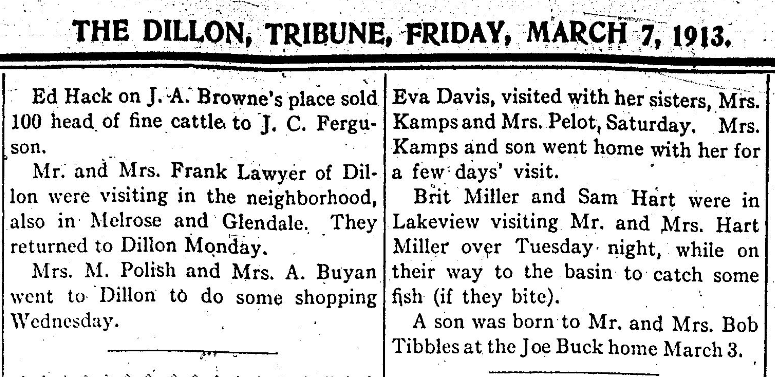
Robert Tibbles was born in Lakeview, Montana on March 3, 1913 to Walter Stillman Tibbles and Esther E. Rote.  Esther is the daughter of Margie Parmer, who is Samuel and Hettie Parmer’s daughter.  Lakeview, MT,  which today is near the entrance of both Red Rock Lakes National Wildlife Refuge and Beaverhead-Deerlodge National Forest, is about 90 miles from Dillon, MT. In 1913, there was no wildlife refuge or national forest, but there was a community of ranchers, railroad workers, and ordinary folks.  The Dillon Tribune reported news from the surrounding areas, including Lakeview.  I always like browsing through old newspapers.  The ads are especially fun to read.  I found copies of The Dillon Tribune at montananewspapers.org, which is a website of the Montana Historical Society.  The Lakeview section of the March 7, 1913 paper has a short announcement of Robert’s birth, shown below.  Small town newspapers are full of gossip.  You want to know who went to the big city to go shopping?  Just read the paper!

tibbles birth announcement

I have not researched if Joe Buck is a relative of the family, or why they were at the Joe Buck home.  However, that name will come up again in Robert’s history.  We do know from some other records that Robert’s parents were “squatters” on a home in the area.

Robert is found in the 1920 census, at the age of seven, living with his family in Grayling District, Gallatin County, Montana.  He lived next to his great aunt and uncle, John and Lizzie Parmer.  It is possible they had lived there for some time because Robert’s younger brother, Howard, was born in the area in 1915. Howard’s birth was not registered until 1941.  In the birth registration, he is listed as being born in the rural part of Gallatin County, MT, with Lizzie D. Parmer as the attendant for the birth.

Walter and Esther divorced in 1923 after Walter became abusive and abandoned the family.  From the court papers, we know that Walter and Esther had 160 acres they were homesteading five miles West of West Yellowstone.  Life in the West was difficult, required hard work, and was subject to the harsh elements of the Montana winters.  There were no modern conveniences.  I’m sure even at 7 years old, Robert was put to work helping the family with chores and such.  At some point, his mother remarried and moved to Wyoming.

In 1930, Robert is 17 years old and living with an aunt and uncle in Lima, MT.  He was working as a farm laborer.  In 1932, he had moved to Monida, a short distance from Lima, and was worked as a ranch hand for Joe Buck.  Remember Joe Buck?  Robert was born at Joe Buck’s home!  He worked for Joe Buck for six weeks, then he got into trouble.  He burglarized a pool hall and stole $24.  As a result, he spent two years in the state prison.

We next find Robert in Alaska.  I wonder–what took him to Alaska?  He must have liked it because it seems that’s where he spent the rest of his life. In 1939, he married Dorothy Pauloff, a Native Alaskan Indian.  They were both living in Kodiak, Alaska at the time, and that is where they are found in the 1940 census.  He had had appendicitis at some point because his WWII draft registration on January 22, 1941 tells us that he had a scar from an appendicitis operation.

Robert and Dorothy had at least two children, but eventually Robert and Dorothy divorced.  In 1947, Robert married Eveline V. Sly.  And the rest of the story is told in my previous post at A Tragedy in Alaska

Life can be rough, and have ups and downs, good days and bad days.  Robert likely had plenty of bad days–witnessing abuse (and possibly being a victim of it himself), abandonment,  burglary, prison time, surgery, divorce, etc.  At the same time, I’m sure Robert had his share of  good days–friends, fatherhood, wedding days, and eating fresh picked berries.  Learning from the bad days, and savory the good, even amidst the bad, is what life is all about.  Savor the good, and all that is before you. Today can be anything you make it.  What will today be like for you?


A Tragedy in Alaska

Earthquakes can be frightening. Having lived in Southern California, I have experienced a few myself. Some are quick, loud, and jerky. Others are long, quiet, and swayish. In every case, they invoked fear and panic inside me–fear of the unknown.

The recent earthquakes in Alaska reminded me of a relative who lived in Alaska in 1958 during a record breaking earthquake that is still talked about today. I was reminded of the relative because, after the recent earthquakes, the news was reporting the possibility of ground shifting, like quicksand.  Something similar happened in the 1958 earthquake when the side of a mountain fell into the bay and disappeared.

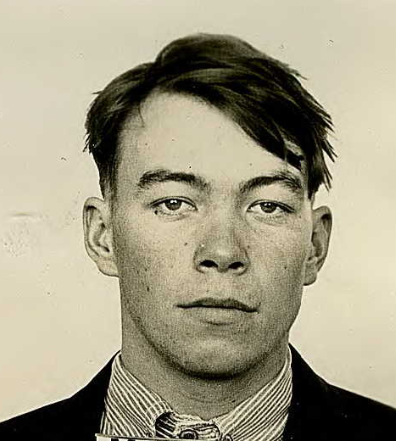
robert w tibbles photo age 20

Robert Walter Tibbles, age 20. Taken from record found at Ancestry.com

Robert W. Tibbles was born March 3, 1913 in Montana. He is the son of Esther Rote and Walter Stillman Tibbles. Esther’s mother is Margie Parmer, who is the daughter of Samuel M. and Hettie Ann Eckman Parmer. Robert moved to Alaska between 1934 and 1939. Eventually he got a job working as a mechanical engineer for the Civil Aeronautics Authority, where he worked for 11 years.

July 9, 1958 must have started off as a fine day. Roberts wife, Eveline, went berry picking on Khantaak Island with a friend, Jeanice Welsh Walton, who was the respected owner of a salmon cannery during a male-dominated industry. I enjoy berry picking and the anticipation of enjoying the berries, as does my family. Perhaps Robert was looking forward to enjoying some berries in the late afternoon when he took a boat out to the island to pick up Eveline and Jeanice.

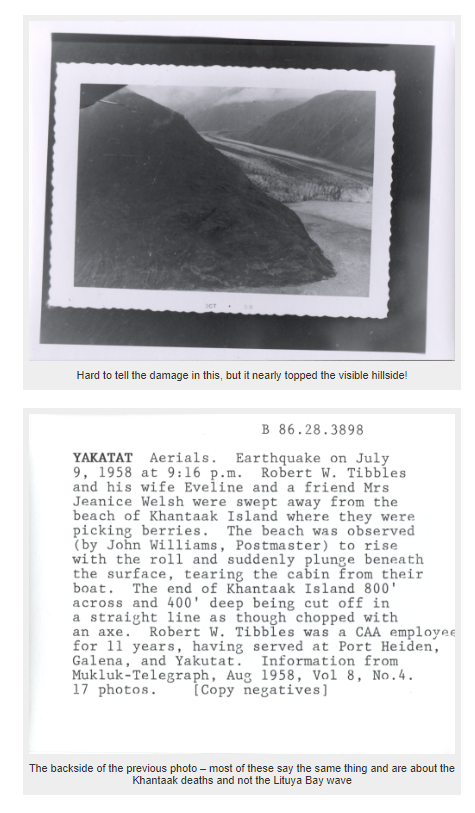
The 8.3 earthquake, centered 45 miles from Lituya Bay, struck at 10:16pm, a time of day that was still light outside. It caused the hillside at Khantaak Island to melt and plunge into the bay.  In Lituya Bay, 100 miles south of Khantaak Island,  falling rocks created the largest wave–a mega-tsunami–ever recorded on earth–1720 feet high.

Robert, Eveline, and Jeanice were on Khantaak Island’s shore that rose and then plunged into the bay.  They perished and were never found.  Here is a summary of the incident as found on the Presumptive Death Certificate for Robert:

robert w tibbles death cert explanation

Excerpt from the Presumptive Death Certificate for Robert W. Tibbles, taken from Ancestry.com

And here is photo and some information about the incident found on Bob’s Blog.

khantaak island

A photo and the information on the back of the photo as shown on Bob’s Blog.


When an earthquake hits, I think the biggest fear is of the unknown.  Is it going to be the big one?  Or is it just a short period of jerking?  You don’t know until it’s over.

An article about Jeanice Welsh Walton can be found at the Alaska Historical Society website.  You can read more about the big wave at the University of Alaska Fairbanks website. Another post about Robert Tibbles will be coming soon.