Margaret Alice Parmer

Margaret Alice Parmer, more commonly known as Margy, was Born Sept 1, 1871. The Civil War had ended five years previously. In 1871, the Franco-Prussian war ended, The Great Chicago Fire devastated thousands, Jesse James robbed banks, and major league baseball started. Also in 1871, some of the first pictures of Yellowstone Park were taken. Perhaps Samuel and Hetty saw some of those photos, never imagining that their newly born daughter would one day be connected to the park.

Margy was the third child of Samuel and Hetty Parmer. At the time of the 1880 Census, Margy was 8 years old. The census indicates she had attended school that year. The Census was taken in June 1880. Her father, Samuel, is shown in the census with an occupation of “laborer.” Her oldest brother, John, was boarding at a Farm not too far away, and not too far from the grandparents, John and Martha Parmer. The second oldest child, William, who was 10 years old, was living at home. Margy’s next older sibling had died 3.5 years previous to the census. Also living at home when the census was taken was Samuel at 4 years old, Annie at 2 years old, and Harry at 9 months old . Margaret’s mother, Hetty, would give birth to another child in one month.
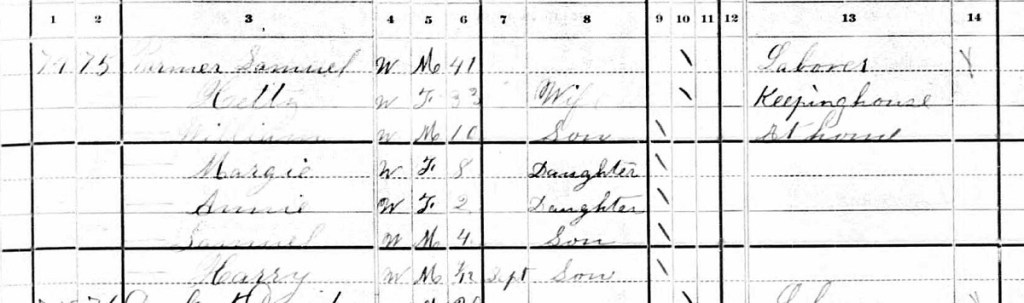
With a houseful, no doubt there was plenty that needed done, and Margie, at 8 years old and the oldest daughter, likely had plenty of chores and babysitting duties to keep her busy when not in school. Of course school was quite different then as noted in my post about John Jacob Parmer’s Youth. The 1880 census is of East Lampeter, and it’s interesting that the census does not list any street names. We do have the map showing the location of John and Martha’s property, which you can see at my post about John Jacob Parmer’s Youth.

As is typical for the time period, there are very few records other than a census for the time of a person’s youth until they get married. The marriage license for Margie is similar to that of her siblings, as discussed in my previous post about Marriages, the Minister, and the Church. She was married 5 Sept 1889 by D.W. Gerhard at 131 South Duke St. There’s more info about Rev Gerhard and a video of South Duke St at my previous post, Marriages, the Minister, and the Church. She would have been 18 years old and Abraham, who was 12 years older than her, was 29 years old according to the marriage license. He was occupied as a teamster.
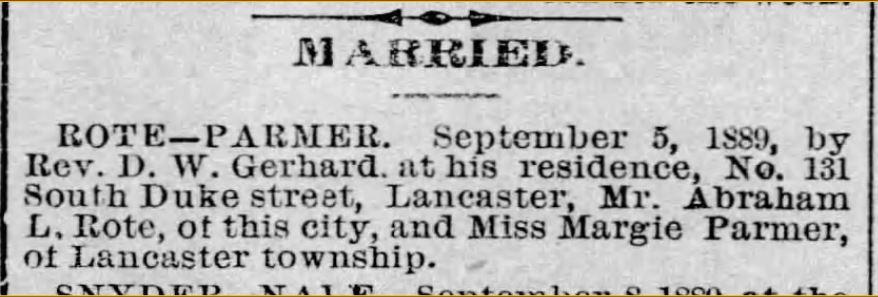
Abraham Rote and Margie Parmer marriage announcement 11 Sep 1889, Wed Lancaster Examiner and The Semi-Weekly New Era (Lancaster, Pennsylvania) Newspapers.com

1890 city directory shows Margie is employed as a millhand and living in Rockland near Old Factory, which is where her father lived. As a millhand, she probably worked in a factory related to textiles. The City of Lancaster’s largest employer in 1880 was the Conestoga Steam Cotton Mills. A nice article about the Mills can be found at https://lifewithldub.blogspot.com/2016/03/the-fabric-of-lancaster-part-i-story.html. You can learn more about textile manufacturing at https://philadelphiaencyclopedia.org/essays/textile-manufacturing-and-textile-workers/. This article focuses on the Philadelphia area, but has a lot of good information, photos, and links for additional resources.

In 1900, we find Margie, living in West Lampeter, married to Abraham Rote and with 5 children: Ester–age 10, Della–age 8, Charles–age 7, Maud–age 6, and Carrie–age 4. Also living at the home is Margie’s brother Harry–age 21, who is listed as a servant. One other individual, 14 year old A[rom] Farrel (the spelling of the first name is difficult to make out), who is listed as a farm laborer and who had been in school for 5 months and was non employed for 5 months (likely while in school), which means he was at 14 years old fully employed when not in school. The younger children had been in school for 7.5 months.

Some time before 1913, Margie and Abraham moved their family West to West Yellowstone, MT. There Abraham worked at and/or managed the Bar N Ranch. We know he was there before 1913 because Margie’s brother John Jacob Parmer and his family succeeded the Rote family in managing the Ranch, and John Jacob Parmer took over that job on June 1, 1913. The Bar N Ranch was mostly used for hay freighted into Yellowstone National Park for the work and stage horses.

Perhaps the Rotes left the Bar N Ranch to start a homestead of their own. A homestead of 160 acres was proved and ownership transferred to Abraham on April 5, 1916. You can see the related documents at the BLM website. As you explore the homestead records, you see many names of the Parmers and Rotes relatives–Battle, Fuller, Gorman, Hutchison, Murray, Rightenour, and Tibbles–who the Parmer’s and Rote’s children married.

Certainly life there in the winter was difficult. It’s possible that they left the area in the winter and returned in the Spring. We next find the family in the 1920 Census.

The 1920 Census shows them living in Ashton, Idaho. Abraham is 60 years old and Margie is 48 years old. They were living with their daughter, Maud, and son in law William R. Hutchinson, and 2 year old granddaughter Vonda.
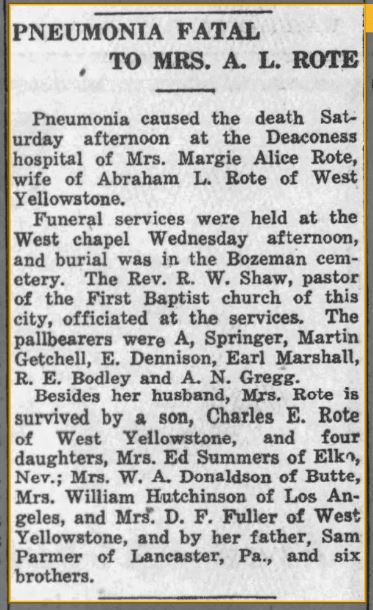
Margie died Nov 27, 1926 of pneumonia at 55 years old, myocarditis contributing. She had lived at 530 Montana Ave, Bozeman, MT for five years according to her death certificate.

Margie Alice Rote death announcement BozemanArticle from 03 Dec 1926, Fri The Bozeman Courier (Bozeman, Montana)

Margie Alice Rote Death Announcement 06 Dec 1926, Mon Lancaster New Era (Lancaster, Pennsylvania) Newspapers.com

Abraham died of a strep infection on Feb 3 , 1933. He was living with his daughter Carrie Rote Fuller at 209 S 7th, Bozeman, MT. He was 73 years old and is listed as being a rancher.

Some of their posterity continued to live in the West Yellowstone area for many years. Others moved to other parts of Montana and to other areas of the country.
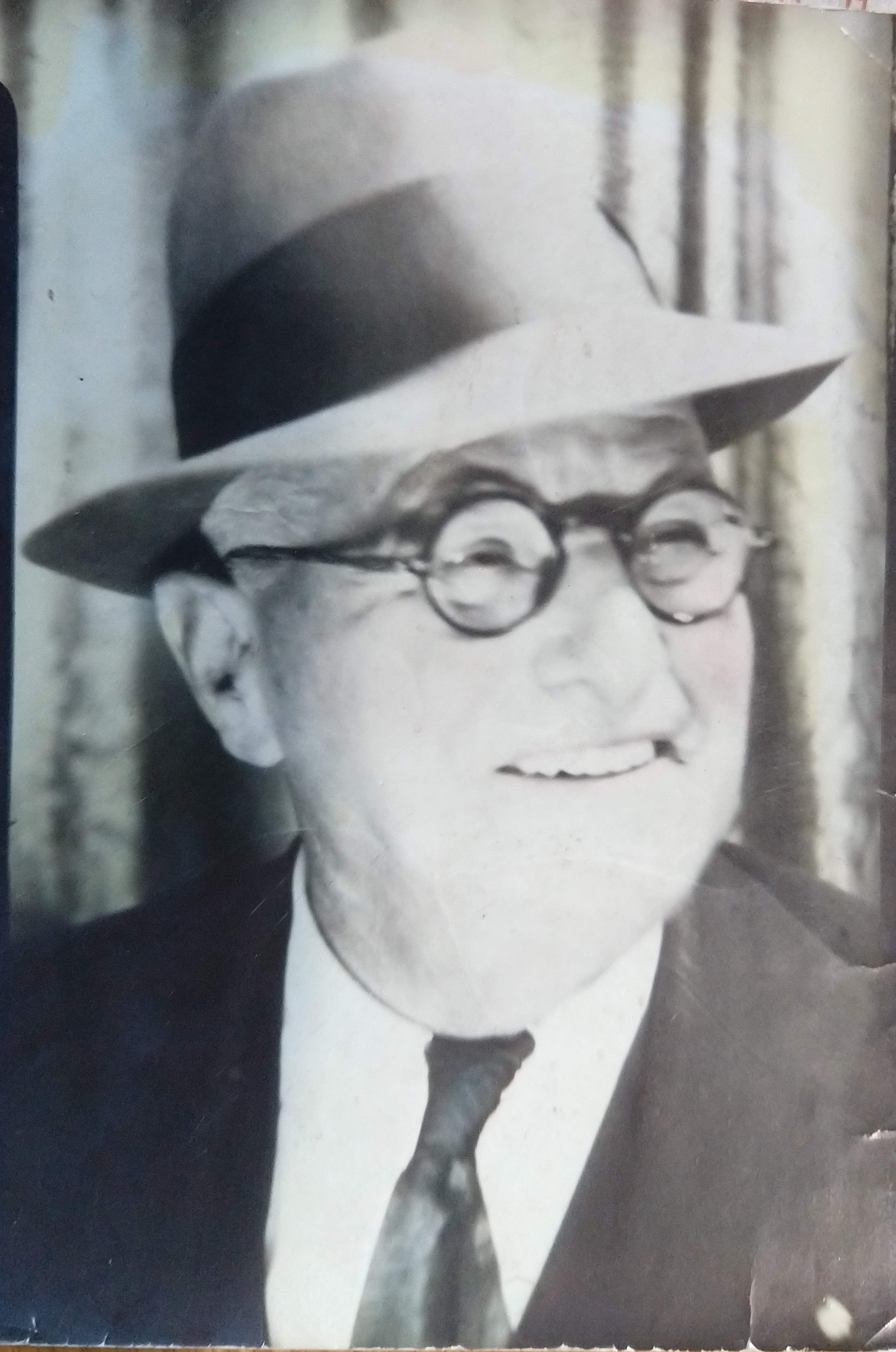
Parmer Siblings

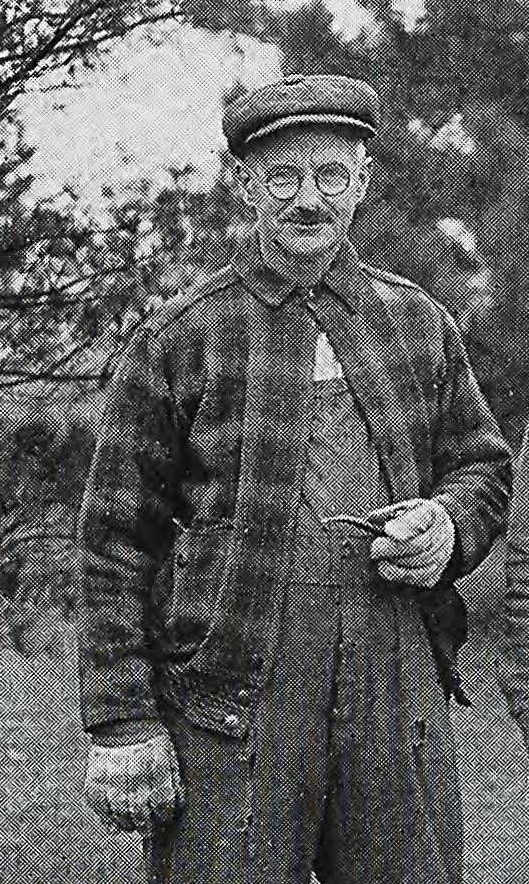
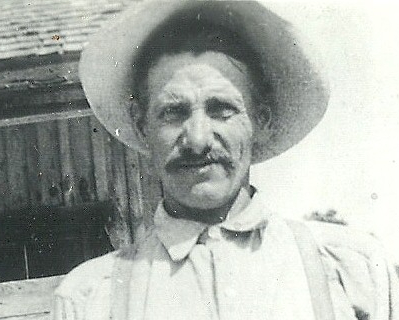
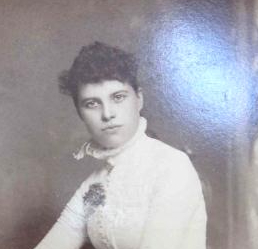
Children of Samuel M. Parmer and Hetty Eckman: Siblings, below, clockwise from top left: John Jacob Parmer, Luther James Parmer, Samuel Elwood Parmer, Aldus Arthur Parmer, Margaret Alice Parmer Rote, William Eckman Parmer. Siblings not pictured: Martha Parmer (died in childhood 1877), Annie E. Parmer, Harry Allen Parmer.

Aldus – Illnesses and Obituaries

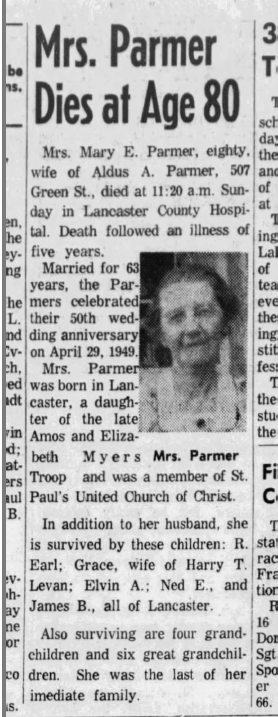
Mary passed away July 29, 1962 at 80 years old. Her death certificate lists cardiovascular disease as the cause of death; however, it also lists “Status Post CVA, old, with Left Hemiparesis.” Medical terminology is not common knowledge, so it’s always a good idea to get definitions, and in this case looking up that term provides some new information that helps us better know Mary. Hemiparesis is a slight weakening, loss of strength, or paralysis, which could be a side affect of a stroke or several other medical conditions. The abbreviation “CVA” means cerebrovascular accident and is the medical term for stroke. The death certificate lists the condition was known for 10+ years, so it’s possible she had a stroke some time before her death that caused her left side to be weakened.

newspapers.com image of Lancaster New Era July 30, 1962

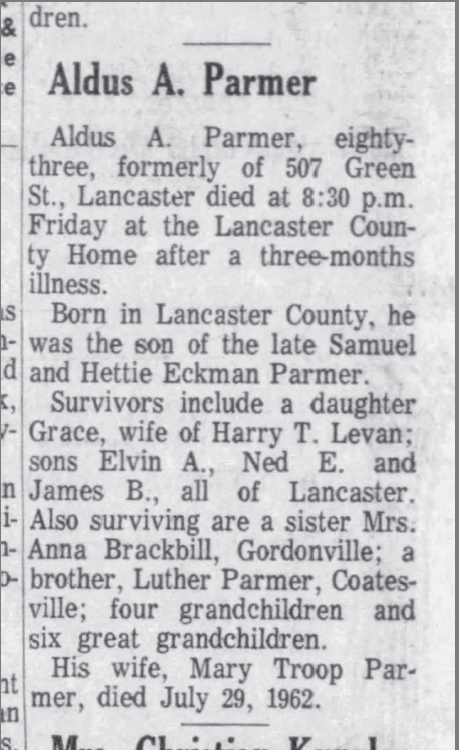
Aldus passed away in 1964, in July, just two years after Mary (almost to the day) and a month after his son Earl. Aldus also had cardiovascular disease. In addition, pulmonary emphysema and brain syndrome were listed as significant conditions at the time of his death. Brain syndrome could be a variety of things related to loss of brain function, from memory loss to loss of motion. Pulmonary emphysema is primarily caused from smoking; however, it is also caused from occupational exposure. Since Aldus was an auto mechanic, it’s likely the fumes and chemicals he was exposed to were a contributing factor. Nevertheless, he lived to be 83 years old, a good age considering the average life expectancy in 1960 was 66.6 years old (Source).

newspapers.com image of Intelligencer Journal July 25, 1964

Mary and Aldus’ granddaughter remembers that Aldus fixed cars and Mary was super concerned with keeping things clean. She remembers visiting her grandparents on Christmas Eve–likely a time much enjoyed and looked forward to by Mary and Aldus.

Aldus Parmer–A Lifetime of Work

What was your first job? How old were you when you started working? I was 16 years old when I started working (other than babysitting). My first job was at Dairy Queen. While school was in session, I worked part time–nights and weekends. During the summer I worked full time. I enjoyed working and earning money. It was exciting being able to pay for things myself. On top of that, we had some fun times at the DQ–the manager-owner made sure of that! Having a job wasn’t a necessity. My parents housed, clothed, and fed me. But earning money to have extras was very motivating.

Remember Aldus was 16 1/2 years old when his mother died in 1897. One census record indicates he had an 8th grade education. Interestingly, the city directory for 1897 lists Aldus individually, as an adult. No occupation is listed; nevertheless, seeing him listed individually is intriguing. It attests to the expectations of youth at the time. So Aldus began to work in factories.

According to the city directories, his factory career began as a box maker, which is what the directories list for his occupation in 1898 and 1899. What kind of boxes he made will likely remain a mystery. Lancaster had a variety of factories. Some that may have required box makers are Hershey’s candy and cigars. Or perhaps it was larger boxes to ship in bulk things like umbrellas or cork products. In any case, the job was likely long hours, for little pay, and in not so good conditions.

Aldus would hold various jobs before finally settling into a career. Here’s what the city directories has listed for him:

1901 Salesman

1903 Fruits

1905 Harness Maker

1907 Driver

1911, 1913, 1916 Salesman (The 1910 Census, Aldus is listed as a Salesman at a seed store.)

1917, 1919 Machinist

On Sept 12, 1918, he registered for the draft. He was living at 507 Green Street, Lancaster, PA. His occupation is listed as an auto machinist working for Queen Motor Co. at 432 N. Queen, Lancaster.

The 432 N. Queen location had been used as a repair shop previous to it becoming The Queen Motor Company. In 1915, Butzer Brothers opened a shop at that location. Edward A. Carney decided to enter the auto business and secured a job there in 1915. Edward would eventually become a partner in the company and then sole owner.

On November 14, 1919, The Queen Motor Co. building at 432 N. Queen burned down. According to the 1924 Lancaster County, Pennsylvania, a History Volume IV found here, The Queen Motor Car Company was “popularly known as ‘the busiest corner in the city.’ No hour of the twenty-four finds the doors closed, no day of the year” (335). Carney held a banquet for his employees “on the evening of January 30, 1920. This was following the November of the fire, and before the new building was even started. He gave his organization the finest banquet and entertainment the city afforded, and without a word of regret for the misfortune, mapped out an enthusiastic campaign for the season shortly to open” (335). The new building was located at a different spot, but it seems that the old location was used as a repair shop by other companies as this 1920 directory shows.

From 1920 Chilton Automobile Directory, found here.

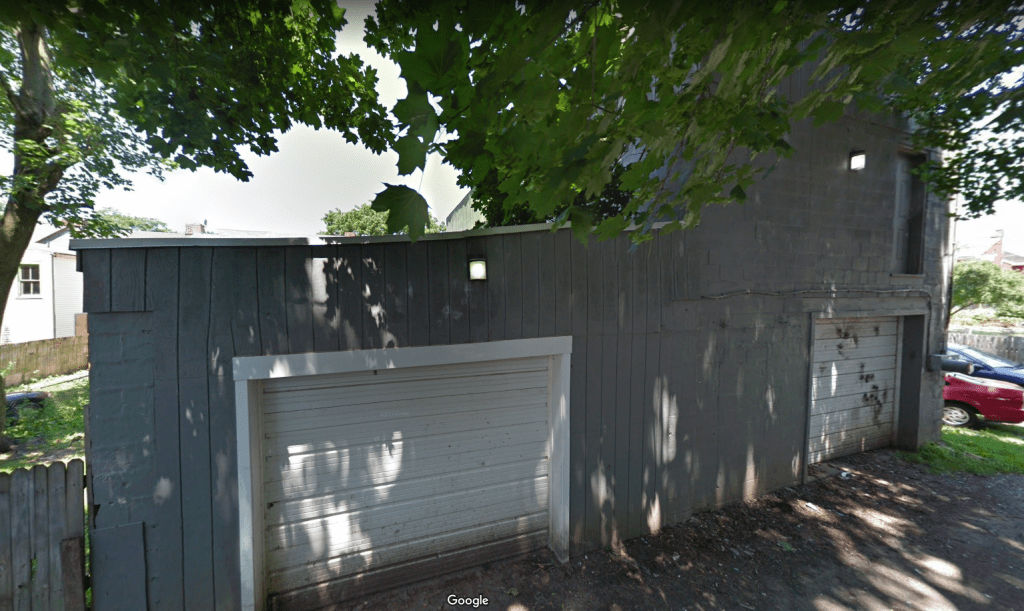
Perhaps based on the mishaps of The Queen Motor Co. building, Aldus decided to go into business for himself. In the 1920 Census, Aldus and Mary live at 507 Green Street and own the home with a mortgage still on the property. Aldus is shown as age 39, which is consistent with him being born in 1880 and being 18 years old at the time of his marriage. He is listed as a proprietor in the “Garage” industry. Also, the 1927-28 city directories list his occupation as auto repair working in the rear of 507 Green, which is his home. Maybe opening his own garage was out of necessity to provide for the family when the company building burned down. It seems perhaps he did well enough to stick with it because this is his main occupation for the years ahead.

The 1930 Census has a few interesting questions. One asks if the home has a radio. Aldus’ family does not. Also asked is if the individual is a veteran, to which Aldus indicates he is not. Another question asks if the individual was actually at work the previous working day. That’s an interesting question! Aldus’ record indicates he was at work the previous working day. This question was a result of the stock market crash of 1929 and the resulting situation that we refer to today as the Great Depression. If a person indicated they were not at work the previous working day, additional questions, on a supplemental sheet, were asked in an attempt to discover whether or not the person was regularly employed or was without a job. The census unemployment results were controversial and many thought the numbers didn’t reflect the true unemployment rate. Likely some thought they were only temporarily out of work and indicated so when they were really not going back to work. Other unemployment censuses were commissioned as a result.

A few items to note on the 1930 Census is that Aldus and family still live at 507 Green Street where they own the home, which they valued at $4,400. Aldus is listed as 49 years old, still consistent with being 18 years old when he married, but his age at first marriage is listed on the 1930 Census as 19. Mary is listed as being 18 years old at first marriage, but we know from the marriage license that she is 17 years old. Aldus again is listed as a proprietor of a “Garage”. Also of note is that the family has a 25 year old male boarder who worked at odd jobs.

Rear building at 507 Green Street, likely where Aldus’ garage was located.

1940 Census reveals a few more details about Aldus and his family. He is still a mechanic, but now works for City Water Works. He had worked 50 hours the week of March 24-30, 1940. He had worked 52 weeks in 1939 and had earned $1200 during the year. Aldus and Mary’s two youngest sons, Ned (age 31) and James (age 29) lived at home, which was still 507 Green Street. Ned listed his occupation as auto mechanic at his own garage, so it was likely the garage on the home’s property.

So what did Aldus do as an employee of the City Water Works? The 1946 and 1948 city directories provide the link — he was an auto mechanic at the City Bureau of Water. Why did he now, after 20 years being self employed, start working for someone else? The answer may be the Social Security Act of 1935. In order to qualify, he would have had to be employed. Working for someone would have likely been the best option to maximize his benefits.

With our first indication of his being a machinist in 1917, Aldus spent over 30 years as an auto mechanic. He had been employed for half a century. He would have been 65, and thus eligible for Social Security benefits, in 1945. It appears from the city directories that he retired around 1950.

Aldus–Starting Off Young

An interesting fact shown in the 1940 census is the highest grade of education completed. Aldus is shown as completing 7 grades. Mary completed 8. Of Aldus and Mary’s sons, Ned is shown as completed 8th grade, and James had what looks like 4 years of high school education. Historically, from 1850, only about 60% of youth ages 5-19 years old were enrolled in school until about 1910 when the percentage began to increase (Source for all statistics in this paragraph). Of those enrolled, they were virtually all in elementary school. Until 1910, less than 10 our of every 100 youth aged 17 had completed high school. Even in 1940, only about 25% of the Caucasian population aged 25+ had completed 4 years of high school. Likewise, college admission rates were extremely low. Although the number of enrollments in college began to increase around 1910, enrollment didn’t really take off until about 1950. In 1870, 20% of the population aged 14+ were illiterate, and the percentage remained in the double digits until after 1900.

I share all these statistics because they are really helpful in understanding the differences that existed in our ancestor’s lives. What seems so basic to us today was just not so basic in the past. As a result, we have to look at history from the eyes of those who were living it. Just earning a living to survive was so time consuming then, producing the very basics of food, clothing, and shelter. It helps us to understand why small children were hired out and why teens stopped going to school and were employed full time. Mindsets, family patterns, and life circumstances stick around from generation to generation, which we see in the history of education. Nevertheless, situations change over time. Referring back to the 1940 census, Ned, who was born in 1909, had completed 8 years of education; however, James, who was born in 1911, appears to have completed high school. Just the two years difference in birth likely boosted James’ educational opportunities.

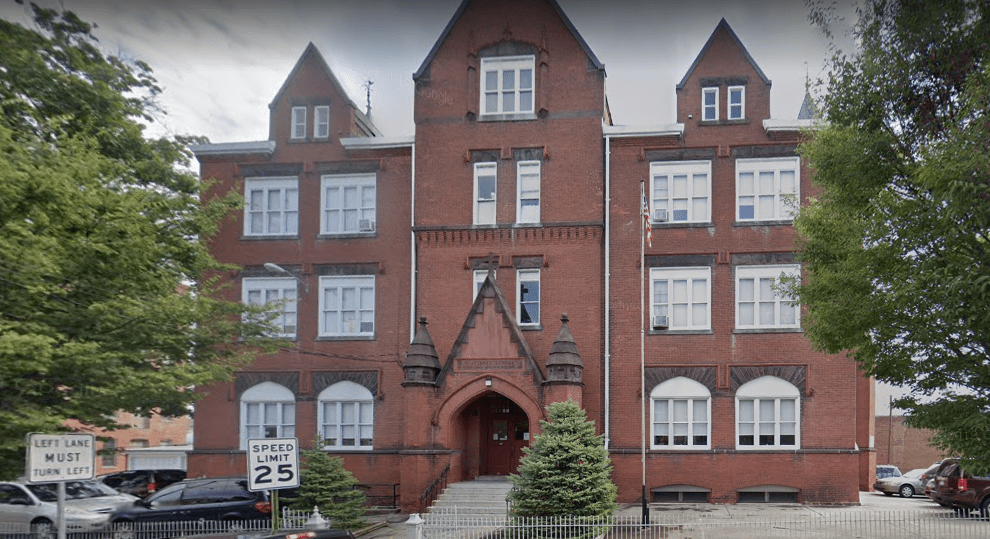
Lancaster School building built in 1892. Former one story school buildings were on both sides of this building. It’s possible that Aldus went to both the one story buildings and this building for his education. Photo from Google Maps. More information about this school, and the history of schools in this area, is found here.

Let’s get back to Aldus, who is shown as completing 7 grades of school. If he started school around 8 or 9 years old, he would have completed his 7 grades at about 15-16 years old. Remember that his mother died in 1897 when Aldus was 16 1/2 years old. It’s likely that he had finished his education and was employed at the time or shortly after. This was common for the time. I have a fifteen year old daughter. She’s still in school and she does not have to worry about working to support herself or her family. Life is different now. For Aldus, it was just the norm. Very likely, his friends had stopped going to school and were getting jobs too. And so the beginning of an adult life began at 16 years old.

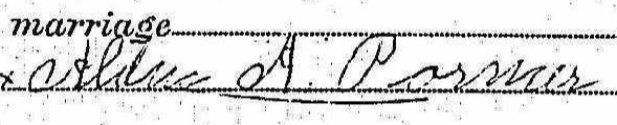
What do people do besides work when they are an adult? Getting married is quite common. About two years after his mother died, Aldus married Mary E. Troop. The marriage certificate says Aldus was 21 years old and Mary was 17 years old when they applied for a marriage license on April 25, 1899. If the date is correct, and his birthday is correct, he would have been 18 at the time, not 21. They were married April 29, 1899. In Pennsylvania in 1900, the legal age to marry without consent from a parent was 21, so it’s likely Aldus lied about his age so he wouldn’t have to get consent from his father. Why he felt he had to do that will likely remain a mystery.

Signature on marriage license docket

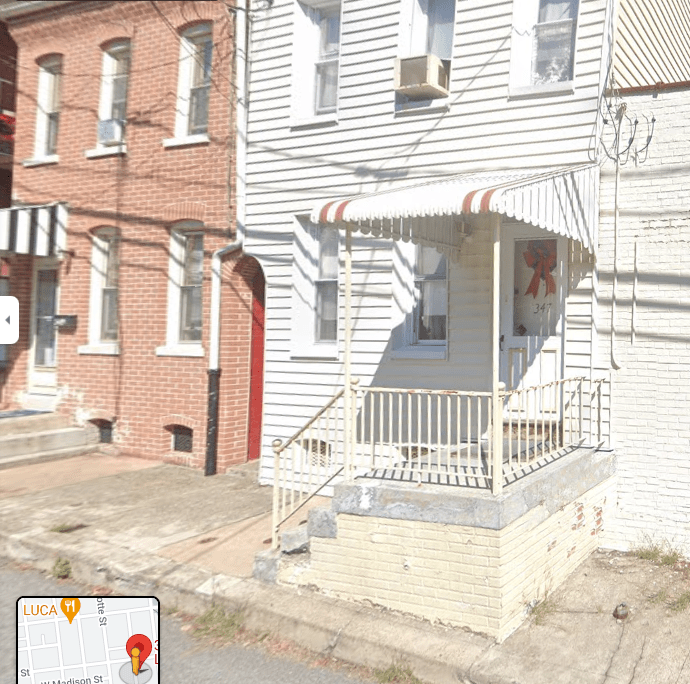
In June 1900, Aldus and Mary lived with her Parents at 347 North Concord Street. They would have been married less than a year.

347 N Concord St, Lancaster, PA. This home is listed on zillow.com as being built in 1900. Photo from Google Maps.

The 1900 census indicates that Mary had not given birth to any children. Aldus’s birthday is listed on the census as Nov 1879, although the provider of the family information may have gotten the year incorrect; however, his age is listed as 20, which would mean he was 19 when he married, not 21 or even 18. On the other hand, if he was born in 1880, he would have been 19 years old in June of 1900 as he wouldn’t have had his 20th birthday until November. I’m always amazed at the inconsistency of ages in historical records. I’ve written about that for several of his siblings.

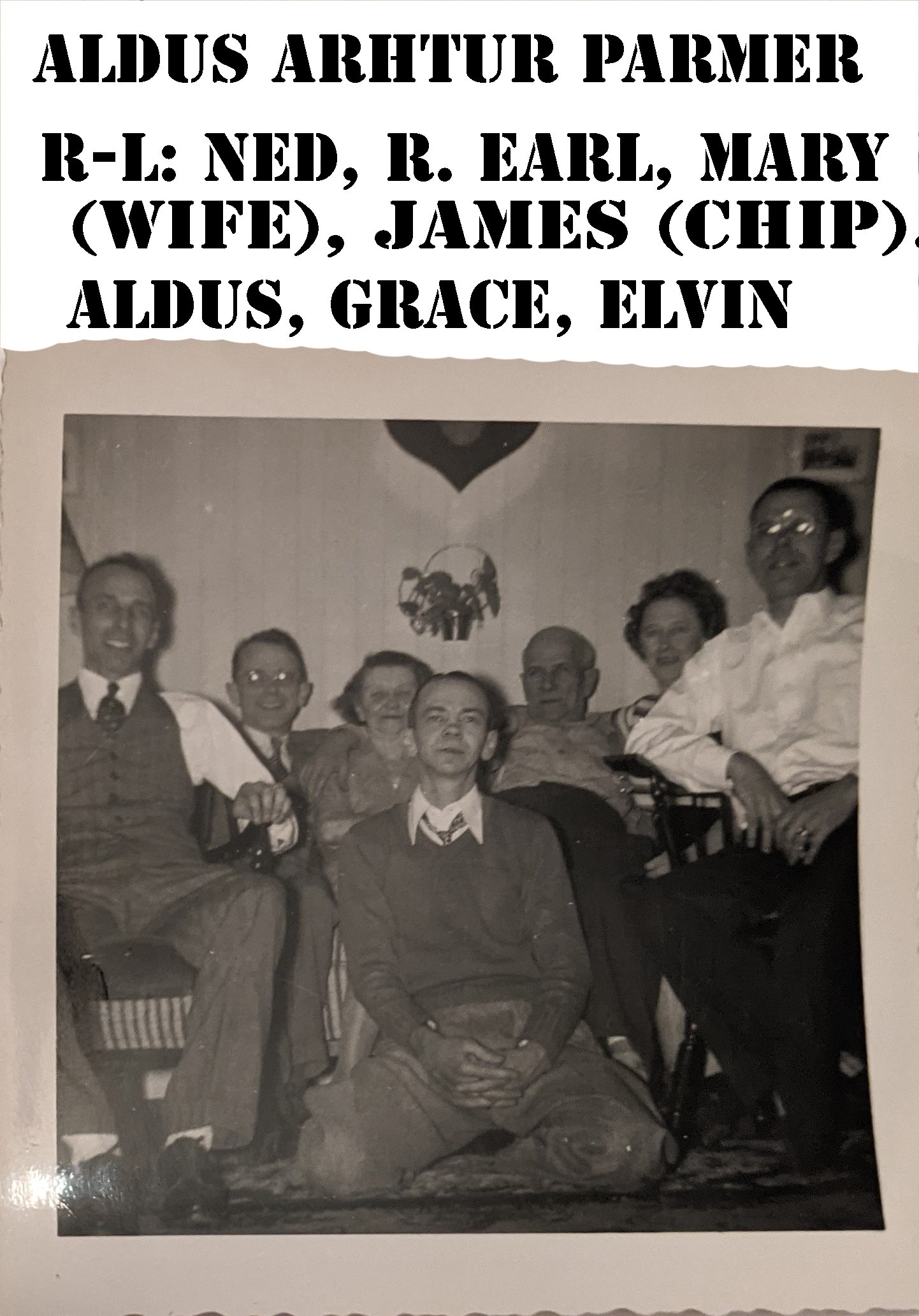
The 1910 Census, taken in April, shows Aldus is 29 years old. This would be consistent with him being born in 1880. It also indicates that he and Mary have been married 11 years, which is also consistent with Aldus being 18 years old at the time of his marriage. Aldus is listed as a Salesman at a seed store. Mary is listed as being the mother of 4 children, 4 of which are still living. This is interesting as I found on Elvin’s birth certificate that he is the fourth child born, with three still living. Elvin was born in 1906. His younger brother, Ned, had been born and was listed in the 1910 census, which means the census record is likely wrong and should indicate 5 children had been born and 4 were still living. Aldus and Mary had six kids. Raymond Earl, Grace, a baby, Elvin, Ned, and James.

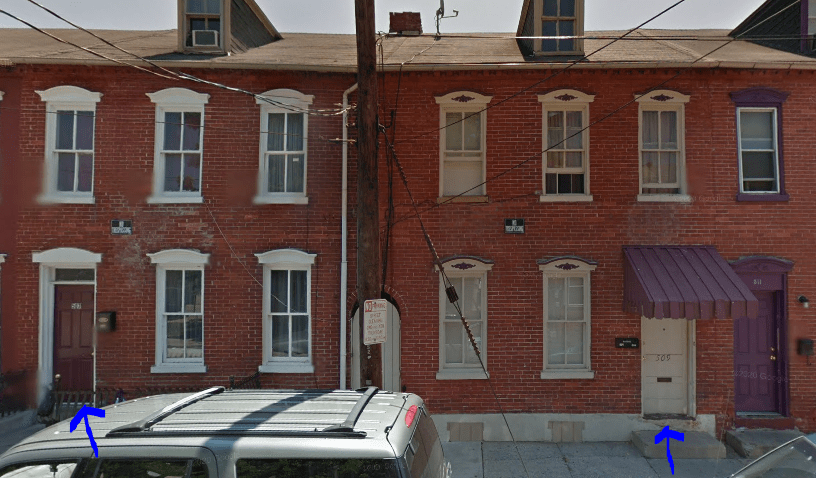
Aldus and Mary lived with their family at 509 Green Street, which they were renting, and were living next to Aldus’ brother William and family who lived at and owned 507 Green Street. Eventually, William and his family would move to Florida and Aldus and his family would buy William’s home.

507 Green Street on left and 509 Green Street on right. Map from Google Maps. Home built in 1900.

So what did Aldus do to support his family? That will be the topic of the next post.

Gray-Eyed Aldus Parmer

Aldus made his entry into this world on November 28, 1880. That was a Sunday and just 3 days after Thanksgiving day. He arrived into Samuel and Hetty’s home with 6 living siblings. One sister, Martha, had previously died in 1877 at 3 years of age. The oldest sibling, John Jacob was 13 years old. His mother, Hetty, must have been very busy because her two youngest children at the time were not very old–Annie was not quite three years old and Harry had recently turned one year old. Samuel was five, Margaret was nine, and William was eleven.

A new baby brings lots of joy, and, as every new mother knows, a lot of exhaustion and sleepless nights. I’m sure the children had chores and helped out. Still, cooking and cleaning were a whole lot different then. There were no refrigerators for home use yet–that wouldn’t be for about another 25 years–but the home may have had an icebox. The stove would likely have been a cast iron or steel stove that burned wood or coal (Source). And doing laundry? That was a lot of work. A pail of water, a plunger, and a washboard were the common implements, along with homemade lye soap, which was quite a process to make too (Source).

In 1918, according to the draft registration card, Aldus had black hair and gray eyes. The gray eyes is interesting. I was born with dark brown eyes and had dark brown eyes for many years. Somewhere along the line, my eyes have changed color and are now more hazel. I wonder when Aldus’ eyes became “grey.” He’s also shown as medium height and slender build at registration.

The WWII draft registration card is more specific. Aldus is included in the April 1942 “Old Man’s Registration.” This draft was the Fourth Registration and was for men ages 45-64 who were not already serving in the military. At that time, he was 61 years old, standing 5’5″ tall, weighing in at 190 pounds, and had gray hair and, still, gray eyes. He also has a scar on the end of the index finger on his left hand.

WWII draft registration card. Image from “United States World War II Draft Registration Cards, 1942,” database with images, FamilySearch (https://familysearch.org/ark:/61903/1:1:VQNQ-M82 : 14 March 2020), Aldws Arthur Parmer, 1942; citing NARA microfilm publication M1936, M1937, M1939, M1951, M1962, M1964, M1986, M2090, and M2097 (Washington D.C.: National Archives and Records Administration, n.d.).

So it appears that Aldus grew up with black hair and gray eyes. Tragically, when he was 16 1/2 years old, his mother died. We don’t have any information regarding her death in 1897. If mothers were as central to their children’s lives then as they are now, I imagine that had a profound affect upon Aldus.

What was life like for Aldus after his mother died? We’ll take a looks at his life in the next few posts.

Tribute to John J.

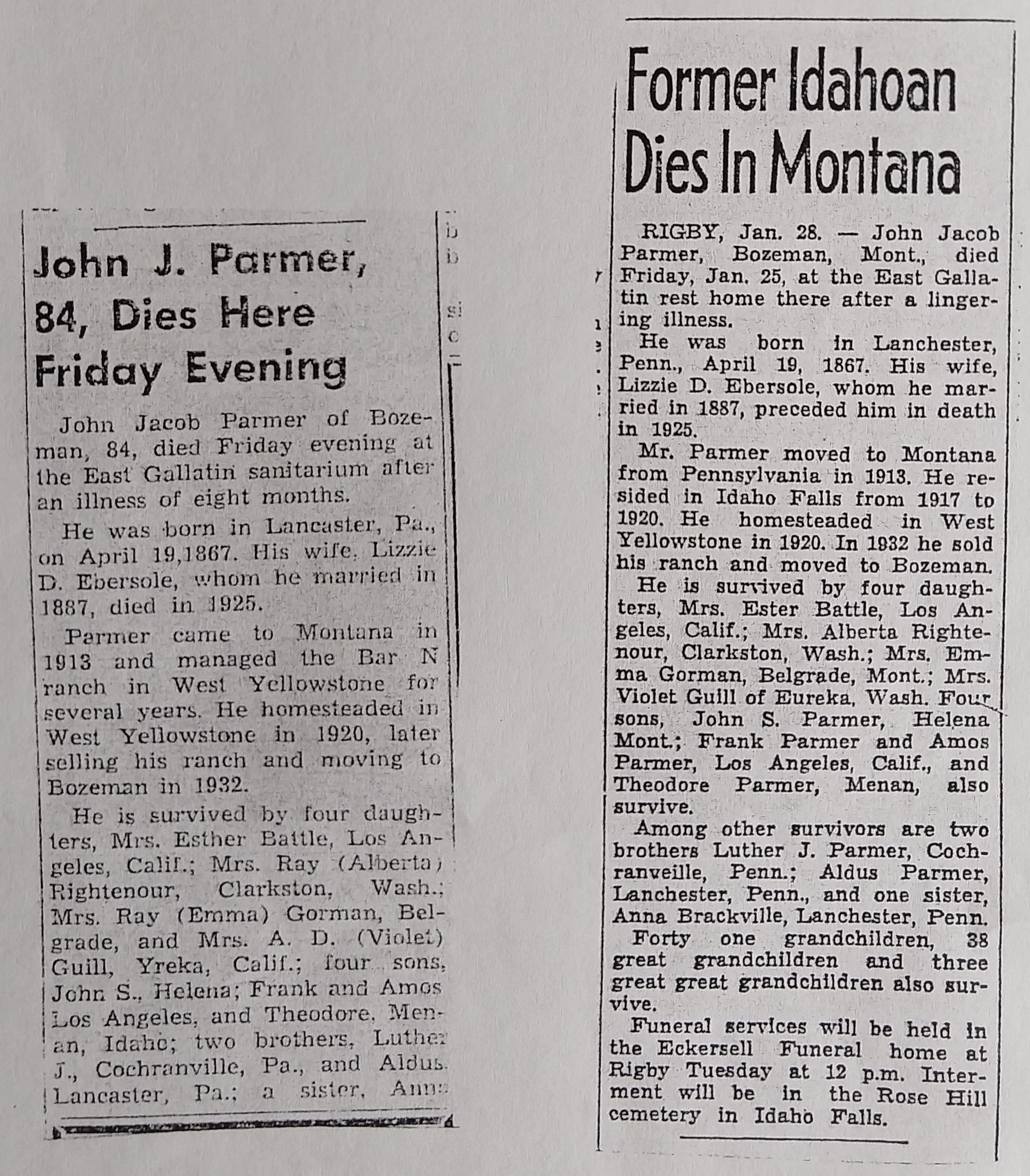
John Jacob Parmer passed away January 25, 1952.  He had heart disease and had been in a long-term care facility for eight months.

IMG_20200823_090403567

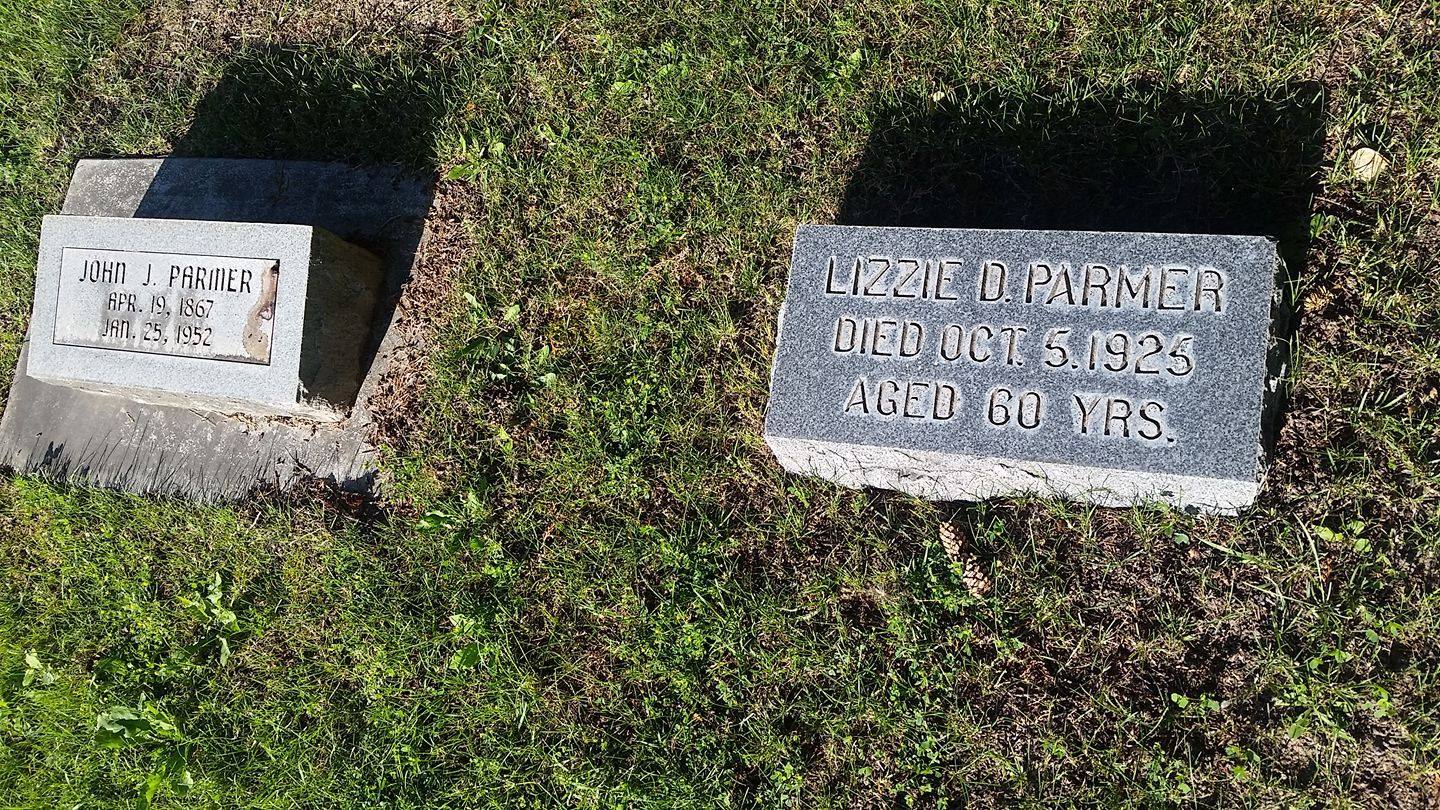
Although he passed away in Montana, the funeral services were held in Rigby, Idaho and he was buried next to Lizzie in the Rose Hill Cemetery in Idaho Falls, Idaho.


john and lizzie headstone

Surviving at the time were 8 children, 41 grandchildren, 38 great grandchildren, and 3 great-great grandchildren.  At his funeral service, the following was said:

My first recollection of him was the interest he took in the children [referring to John’s grandchildren].  He was enjoying them very thoroughly….Grandfather Parmer loved very much his family….He expressed the desire to visit the rest of the children.  He missed them and wanted to see them.  I have heard him on many occasions express anxiety to their welfare and express his love for them and his desire to see them.

So for those who are descended from John J., know that he cared about you and your welfare.  And for those who are not descended from John J., be assured that your grandparents, and all those who came before you, cared about you and your welfare.


IMG_20181001_185228763

John Jacob Parmer

I never knew my Great Grandfather John Jacob Parmer.  Yet I am glad for his life.  For some reason, I am drawn to my ancestors.  I echo this quote:

I am bound to them, though I cannot look into their eyes or hear their voices.  I honor their history.  I cherish their lives.  I will tell their story.  I will remember them.  — Author unknown.

Life as a Widower

John Jacob never remarried after his wife died.  I often wonder what leads a person to remarry or stay single after a spouse passes away.  He lived 27 years as a widower.  At his own funeral service, it was said that “He missed greatly the association of his mate that he loved and lived with for many years.  He lived alone for some 27 years, but he never lost that love or lost sight of that smiling face that lived with him.”


During those years as a widower, I imagine he had lots of time to spend with his posterity.  In 1932, he sold his property and moved to Bozeman, Montana.  Here are a few photos from his later years.


This slideshow requires JavaScript.

A Bit About Lizzie

On October 5, 1925, Lizzie passed away.  Her appendix had ruptured, causing peritonitis, which is inflammation of a membrane that lines the inner abdominal wall. The inflammation is from infection, which can lead to infection throughout the body.  I haven’t researched Lizzie’s life specifically, but I love the photos of her that I have gathered.  She’s always smiling.  From the photos, it’s obvious that her life was full of hard work and was without modern conveniences.  Nevertheless, her smile is indication that no matter life’s circumstances, a person can be happy.  Enjoy the slideshow!

This slideshow requires JavaScript.


Homesteading in Montana

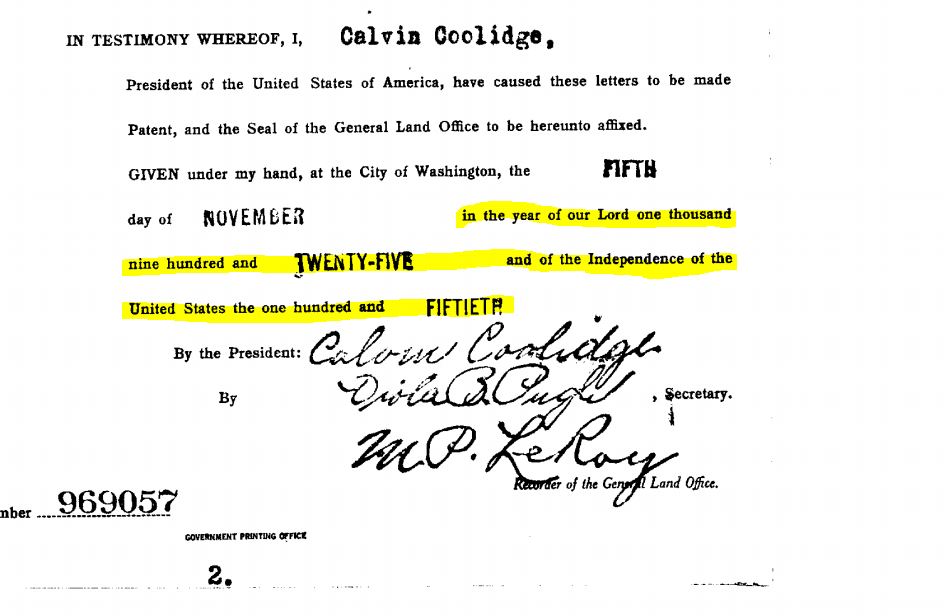
John Jacob decided to get his own homestead in Montana.  He got a piece of land near the back waters of Hebgen Dam.  You can read the land grant at this site.  It’s dated November 5, 1925.  I thought it interesting that, after the date, the documents states the number of years of independence–150 years.  The United States was so young!  And it still is, relatively.

land grant signatres

I wondered if Calvin Coolidge signed the grant personally.  So I did a little research and found that autopens, machines that use a pen to write a signature, were not really employed until the late 1940’s.   But most presidents had at least one person that signed documents for them, especially land grants.  So it’s very unlikely that the signature was by Coolidge himself.

Even thought he Land Grant is dated November 1925, John J. lived there before that time.  A few biographical accounts place them on the property in 1920, after leaving the hay ranch.  In addition, we have photos of Lizzie on the property, and she passed away the month before the land grant date.  So we know they were on the property before the dated document.  So I did a little research and found that under the 1862 Homestead Act, a person could fill out an application, move onto the land, and live on it for five years.  After the five years, they could complete paperwork to receive a patent upon providing evidence that they met all the stipulations of living on the land continuously for the five years.  So if they filed the initial application in 1920, then the five years would be up in 1925.  And that corroborates the biographies that they moved to the homestead in 1920.

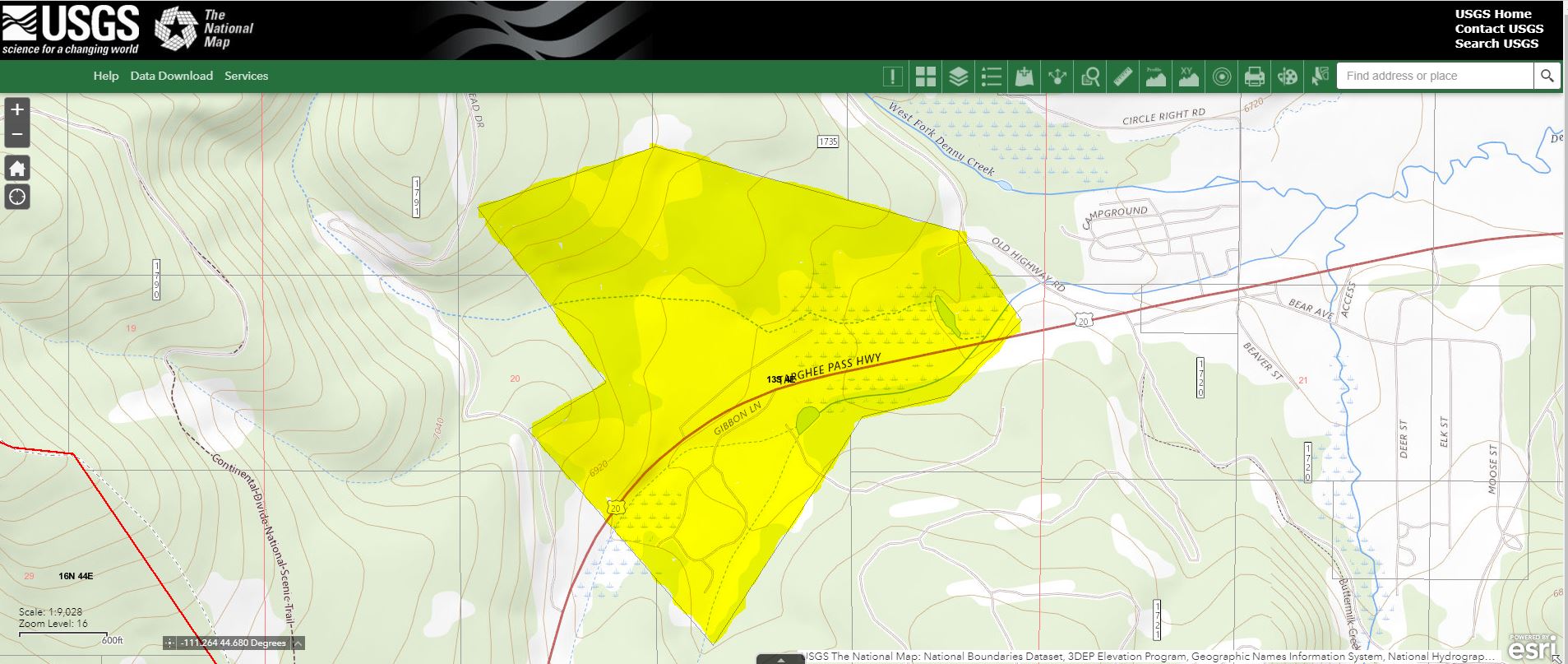
The property included 147.58 acres. Here’s a map that shows the property, which is the yellow highlighted area.

blm image jj parmer land grant highlighted

If you have ever driven from Island Park to West Yellowstone on Highway 20, you have driven right through what was John Jacob’s property.  I have driven right through it and didn’t know!  It’s quite a large piece of land.  Below is a photo taken before June 13, 1934. I know that because there is a stamp on the back that it was received in a loan office on that date.

PTDC0031 (2)

Also on the back of this photo it says Hwy 191.  That confused me for a bit because the highway that runs through John J.’s property today is Highway 20.  After a little research, I discovered that Highway 191 was designated in 1926 and ran from Idaho Falls, Idaho to West Yellowstone, Montana on what is now numbered Highway 20.  So that confusion was cleared up.

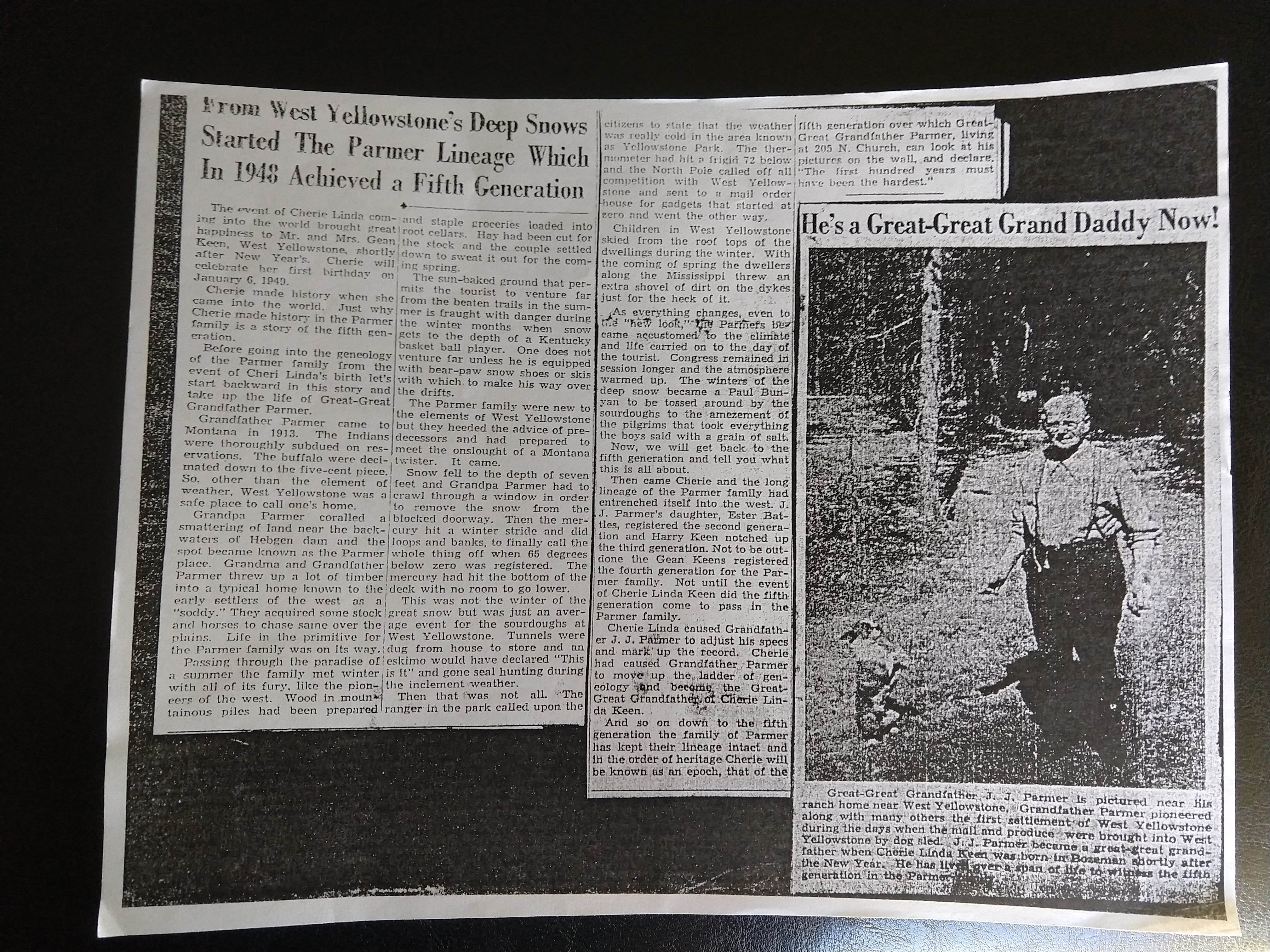
The winters in that part of Montana were brutal.  The following is from a newspaper article (see image below).  Sorry I don’t have the newspaper name and date, but I will add it if I am able to learn it.

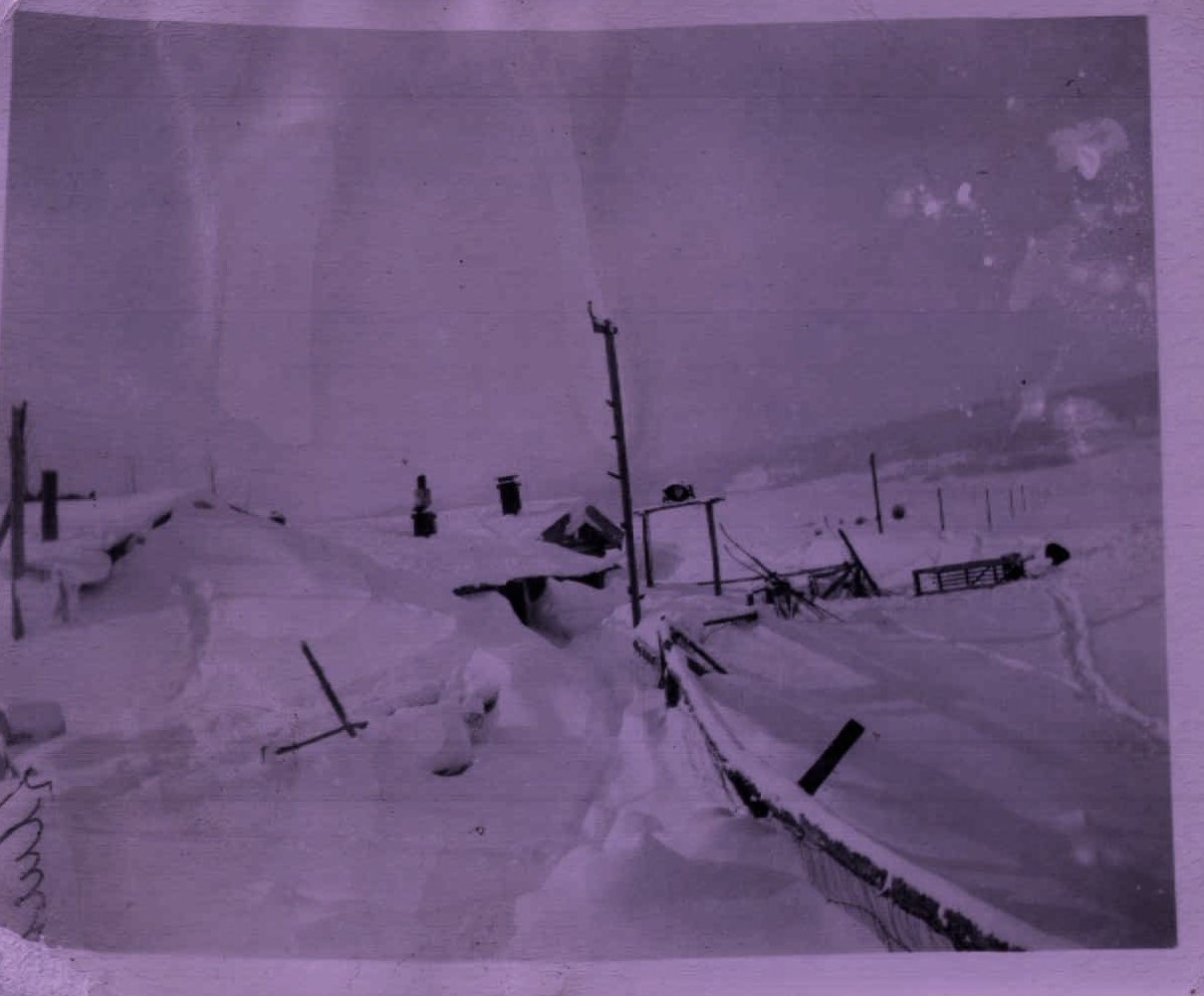
Snow fell to the depth of seven feet and Grandpa Parmer had to crawl through a window in order to remove the snow from the blocked doorway.  Then the mercury hit a winter stride and did loops and banks to finally call the whole thing off when 65 degrees below zero was registered.  The mercury had hit the bottom of the deck with no room to go lower.

This was not the winter of the great snow but was just an average event for the sourdoughs at West Yellowstone.  Tunnels were dug from house to store and an eskimo would have declared “This is it” and gone seal hunting during the inclement weather.

Then that was not all.  The ranger in the park called upon the citizens to state that the weather was really cold in the area known as Yellowstone Park.  The thermometer had hit a frigid 72 below and the North Pole called off all competition with West Yellowstone and sent to a mail order house for gadgets that started at zero and went the other way.

Here’s an image of the newspaper article, which you can probably read if you enlarge it on the screen.  It tells about John J. becoming a great great grandfather.

IMG_20200814_090949868_BURST000_COVER


And here are some winter photos from various years.  The first shows just how much snow there was.  There’s a house under there somewhere!

PTDC0026 (3)


I love this next photo simply because it’s not really staged and it seems to really capture the emotions of the moment.  You can tell it’s a large gathering and everyone is having a great time.

img027

Notice the girls are all in dresses and bundled up.  Some of the guys have skis on still, and there’s a pair of skis stuck in the snow.  Kids are on top of a big snow pile in the background by the building.

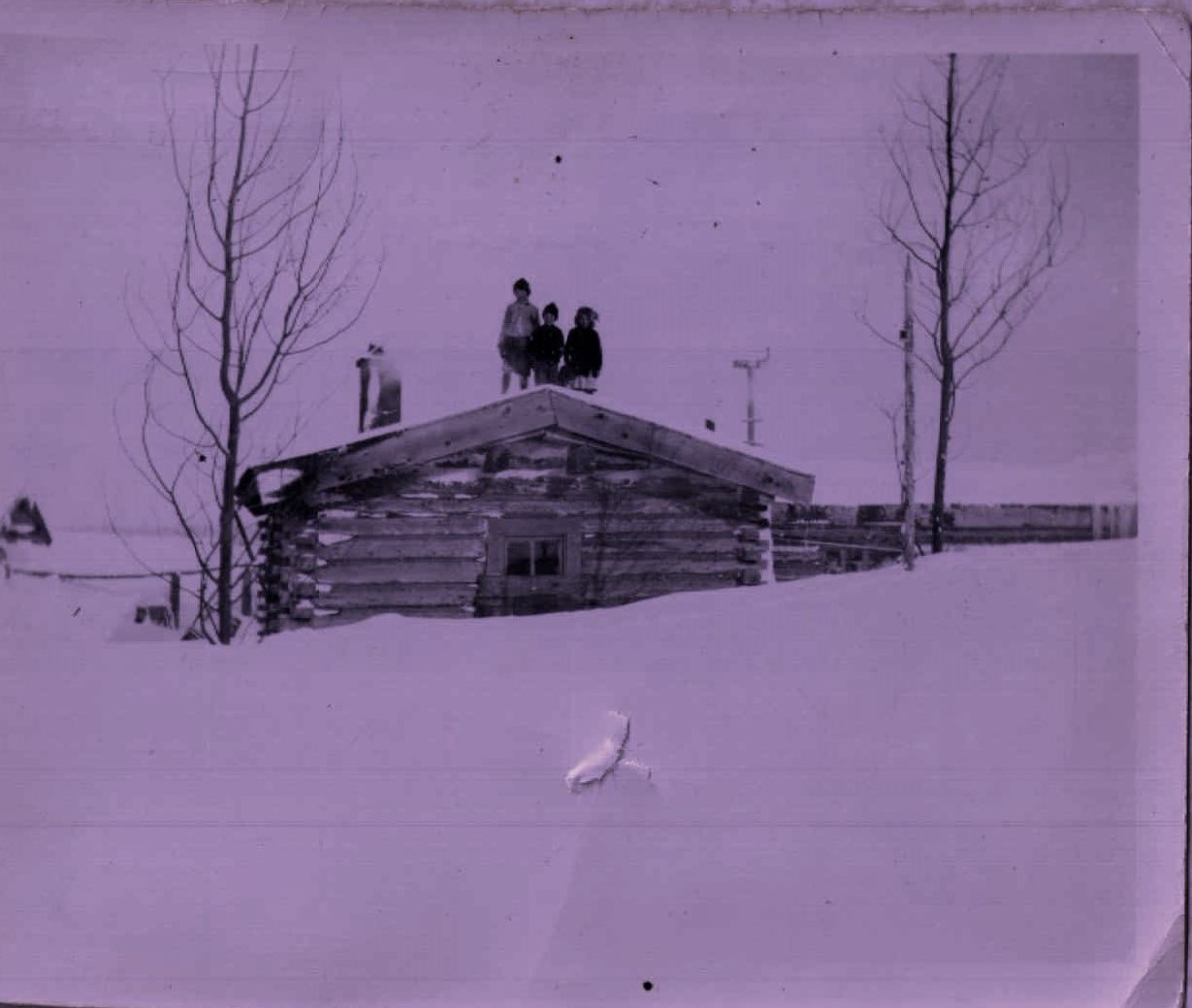
Here’s another picture with the kids on the roof of a home surrounded by snow. This may be their home on one of the ranches, not the homestead.  Or it could be an early photo of the homestead before windows were installed.  In addition, June Parmer Steinmetz said they lived across the street from John J., so this could be their home.

PTDC0017 (2)


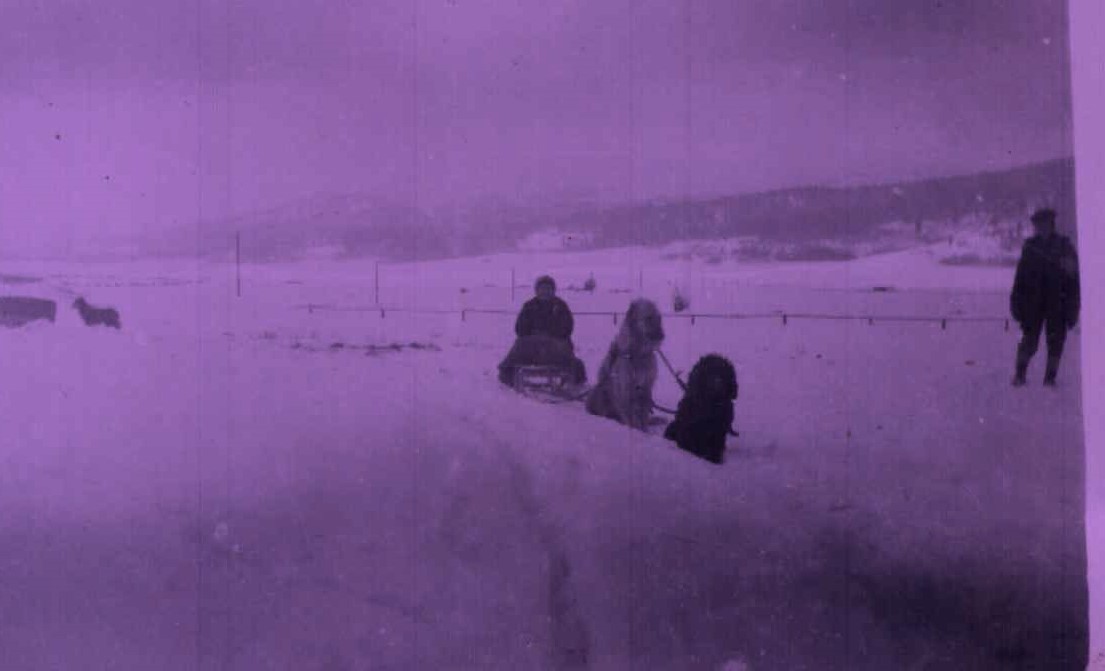
For this next photo, I’m not sure who is standing and who is on the sled, but it looks like the person on the left could be John J. and the person on the sled could be Lizzie.

PTDC0247 (2)


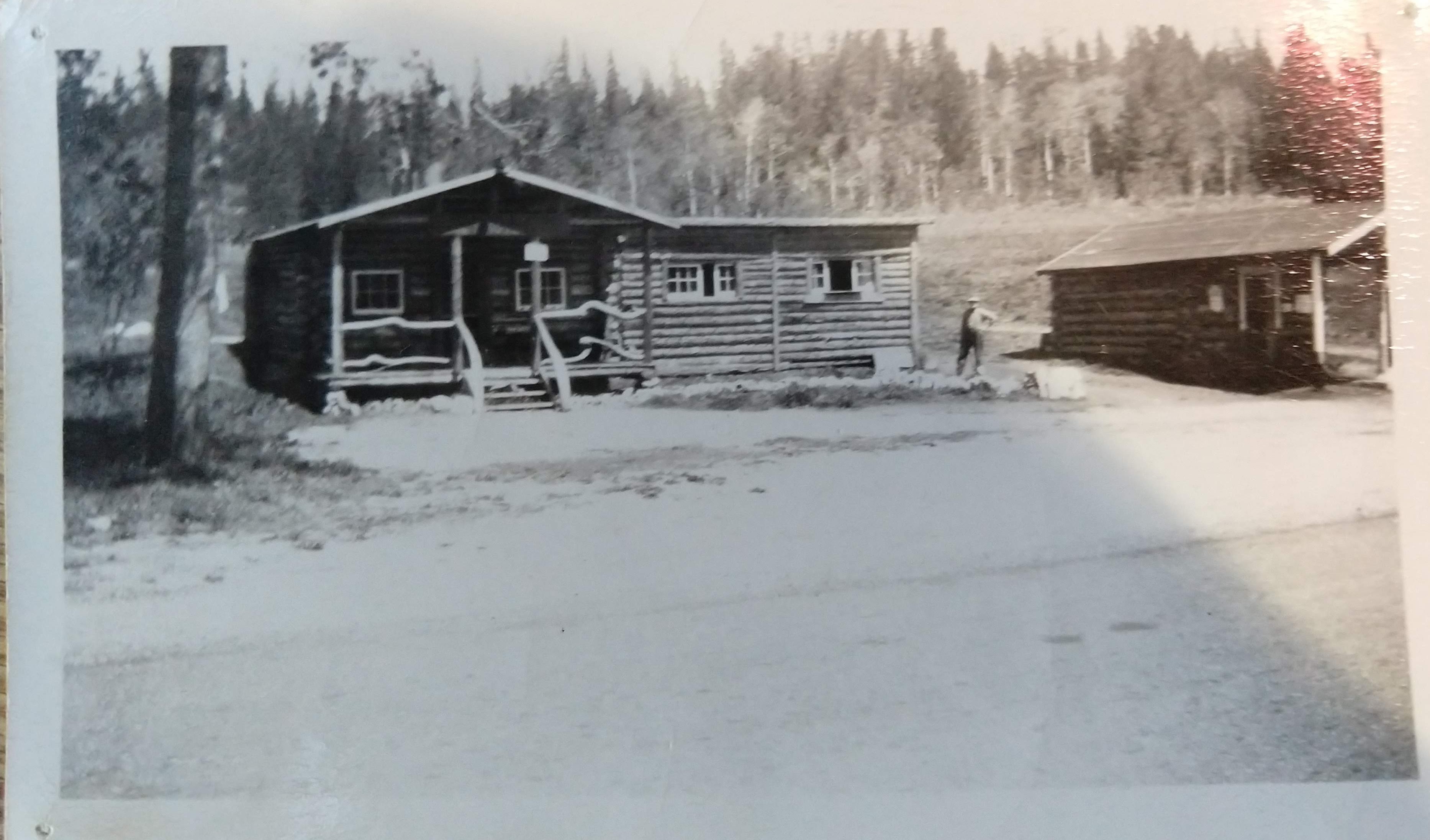
Eventually, John Jacob had a store and gas station at his homestead.  Here are a couple pictures taken at different angles so you can see the surrounding terrain.  The road in front would be Highway 191/Highway 20.

PTDC0003 (2)

IMG_20181001_185904337 (1)

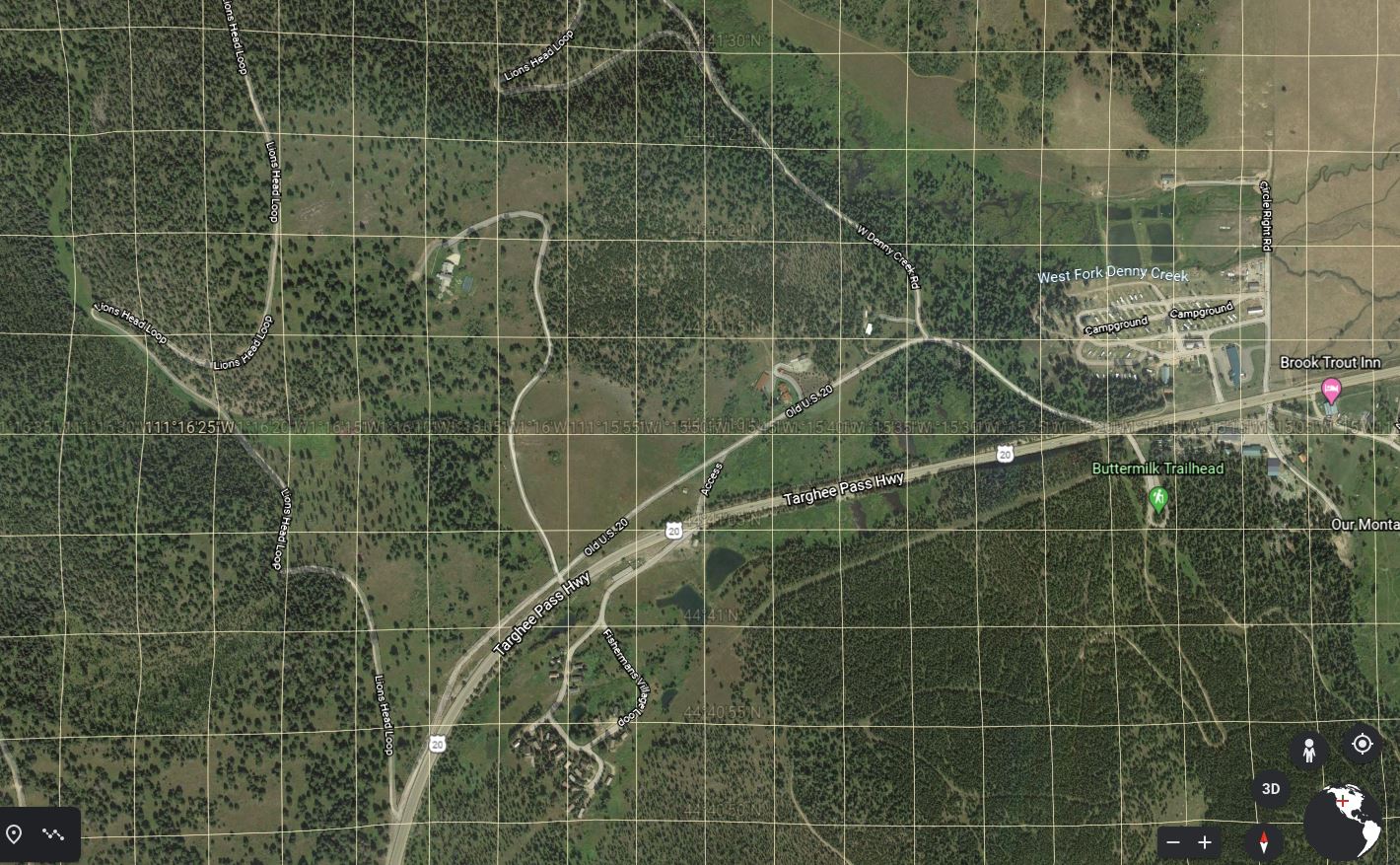
You can see that there were a lot of trees on the property.  And the earlier photo shows some of the land had a lot of sage brush.  It was a lot of acres of undeveloped, unused land.  How much of it has changed in the last 100 years?  There’s more homes for sure.  Maybe less trees?  But still a lot of pure nature.  Here’s an image from google earth that shows the same property today.

google earth image of jj parmer land grant

John and Lizzie’s granddaughter, June Parmer Steinmetz lived across the street from the gas station when she was a  child.  She remembers her grandfather being a jolly, happy person. She also said that her grandmother Parmer was very strict.  I imagine she was strict at times, but she also looks like she knew how to have fun.  You’ll read more about Lizzie in the next post.